


Choosing the proper platform for placing advertisements becomes more challenging every year because of the continuous development of both platforms and shifts in audience behavior. One of the most heated discussions in the marketing field currently concerns whether the ads placed on TikTok outperform those placed on Facebook or whether it all depends on the specific type of business.
These platforms provide excellent tools for targeting users, but their mechanisms and audience are very different from each other. To choose the most suitable platform for a particular business, it is necessary to dive into some data.
How targeting works differently
Since Facebook has been around for longer, the platform has accumulated a lot of data based on user interaction, likes on pages, and cross-app activities within Instagram. This allows Facebook to have a well-refined targeting system that enables advertisers to target people of a certain age, interests, and purchasing behaviors.
On the other hand, TikTok uses less information related to demographics and more metrics and statistics related to user engagement and video performance. The TikTok algorithm looks at the way users engage with videos and serves similar videos to people who demonstrate similar behavior, even though there is not enough information regarding their profile.
It means that being successful on TikTok requires making an engaging video rather than targeting precisely.
Difference in content style
- Facebook favors Polish, product-focused creative
- TikTok reward raw, authentic, trend-based video
- Facebook ads are blended with feed posts and articles.
- TikTok ad blend with entertainment content
- Facebook allows more static image options.
Cost, CTR, and CVR comparison
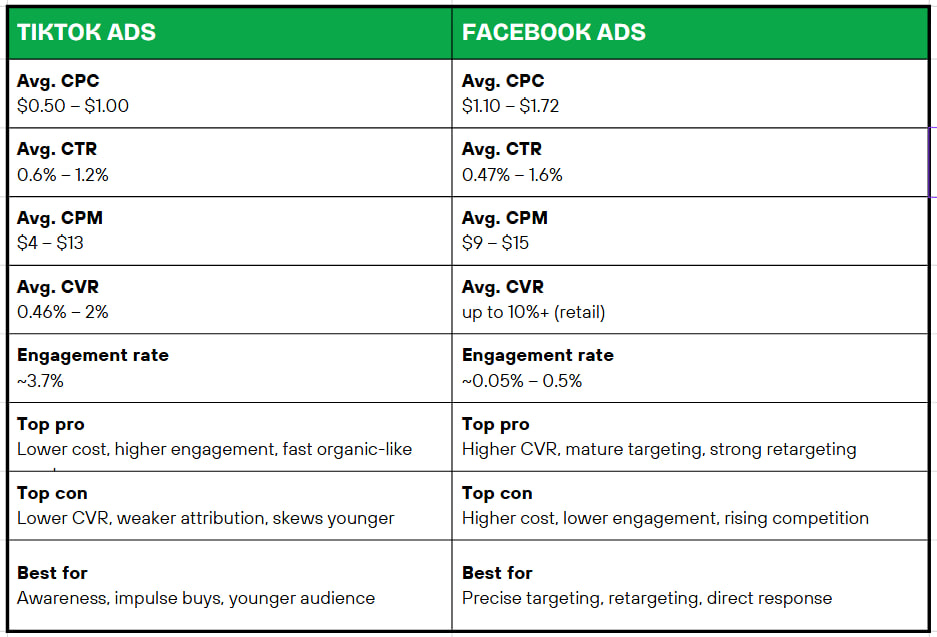
When it comes to budget, cost per result can vary a lot depending on the industry, but many advertisers report that TikTok currently offers lower cost per click compared to Facebook, mainly because there is still less competition on this platform. Average CPC on TikTok usually lands around $0.50 to $1.00, while Facebook often costs $1.10 to $1.72 or more per click.
Click-through rate, or CTR, is a bit closer between two platforms than people expect. TikTok CTR normally shows around 0.6% to 1.2%, and Facebook sits somewhere between 0.47% and 1.6%, depending on the industry. So TikTok is not always winning here; it just tends to be more consistent because of its native, full-screen format.
The metric that really separates them, though, is CVR, or conversion rate, meaning how many people who click actually complete the purchase or want action.The average CVR for TikTok usually hovers around 0.46% to 2%, but Facebook’s CVR, which benefits from its maturity in pixel tracking, can be as high as 10%. The reason why this difference exists is that Facebook’s audience is familiar with the habit of clicking out of their app to make purchases, whereas TikTok’s audience prefers remaining in-app and its tracking system is less developed than Meta’s.
Pros and cons of TikTok ads
Pros:
- Lower CPC and CPM in most industries
- Higher organic-feeling engagement rate
- Great for brand awareness and viral reach
- The algorithm can push content to a new audience fast, even for a small account.
- Strong performance among younger, Gen Z, and millennial users
Cons:
- Lower CVR compared to Facebook in many cases
- Attribution and tracking are still less mature.
- The audience tends to be younger, which makes it less suitable for products targeting older demographics.
- Success depend heavily on creative quality, polish ad often perform worse
- Faster creative fatigue, meaning ad need refreshing more often
Pros and cons of facebook ads
Pros:
- Higher CVR, especially for retail and e-commerce
- More detailed and mature targeting system
- Better suited for retargeting and lower-funnel campaigns
- Predictable delivery and stable algorithm behavior
- Works well for an older audience and is considered a purchase
Cons:
- Higher CPC and CPM overall
- Lower organic engagement rate compared to TikTok
- Cost keep rising as more advertiser compete for same space
- Less effective for pure impulse buys or trend-driven products
- Privacy change over the years has reduced some targeting accuracy.
Which one should the business choose?
There is no definite answer to this question as each of the two social media platforms has its own purpose depending on what you want to achieve with it. But if companies require fast and trendy presence, affordable clicks, and younger audiences, TikTok might be a better choice especially with support from a TikTok marketing agency.
If companies already have comprehensive information about their customers and require higher conversions and a more mature audience, then Facebook is still a good choice.
Many successful brands actually use both together, letting Facebook handle retargeting and detailed funnels where its higher CVR shines, while letting TikTok handle top-of-funnel awareness and viral reach where its lower cost and higher engagement matter more.
Final thought
At the end of the day, choosing between these platforms should be based on where the audience actually is and what part of the funnel business is trying to improve, not just which one is trending more in marketing conversation. Testing small budgets on both, tracking CTR and CVR closely, and then doubling down on what performs, usually give clearest answers than guessing alone.